Wednesday, June 30, 2010
Bread Baking Day # 31 : Bread with Nuts

June BOM Bagels

Adapted from Peter Reinhart’s The Bread Baker’s Apprentice by blossomtostem.net; further adapted by your host.
Sponge
1/2 teaspoon (.055 ounce/1.56 grams) instant yeast
2 cups (9 ounces/255 grams) high-gluten flour
1 1/4 cups (10 ounces/295 milliliters) water, at room temperature
Dough
1/4 teaspoon (.028 ounce/.8 gram) instant yeast
1 3/4 cups +2 tablespoons (8.5 ounces/240 grams) high-gluten flour
1 1/4 teaspoons (.3 ounce/8.5 grams) salt
1/2 tablespoon malt syrup, honey, or brown sugar (or 1 teaspoon diastatic malt powder)
Finishing Touches
1 tablespoon baking soda
cornmeal for dusting
optional toppings: sesame seeds, poppy seeds, kosher or sea salt, cinnamon and sugar, etc.
A day (or two) before you want the bagels (see below for instructions on making the bagels in one day):
Prepare the Sponge.
In a large bowl (if using a stand mixer, go ahead and start it in that bowl) mix 1/2 teaspoon yeast, 2 cups high-gluten flour, and 1 1/4 cups water until it forms a thick batter. This is a very stiff dough, so hand mixing and kneading is recommended. Cover with plastic wrap and let sit until bubbly, nearly doubled in size, and on the verge of collapse, about 2 hours.
Make the Dough.
Add 1/4 teaspoon instant yeast to the sponge and stir. Add the salt, malt syrup or powder, and 1 1/2 cups flour. If using a stand mixer, mix on low speed for about 2 minutes, or by hand for a few minutes or until a dough ball has formed. Slowly add the remaining flour, and mix on medium speed for 6 minutes (or knead by hand for about 10 minutes) or until all of the flour is incorporated. The dough should be smooth, stiff, stretchy, and not sticky or tacky. If the dough feels dry and tears easily when stretched, add a little water, a teaspoon at a time, and knead some more. If the dough feels sticky, add some flour.
Divide and Shape the bagels.
Line a sheet pan with parchment paper and spray lightly with oil. Divide dough into 2 3/4 to 3 ounce pieces, or, if you don’t have a scale, into 9 equal pieces. Roll each piece into a ball, place on parchment, cover with a damp towel and let rest for 20 minutes. With your finger or thumb, poke a hole in each piece and stretch to about 2 inches in diameter. Try to stretch the dough evenly to avoid thick and thin spots. Place on parchment, cover with a damp towel, and let rest for 20 minutes. To test to determine whether the bagels are ready to go into the refrigerator, fill a medium bowl with cool water. Drop one of the bagels into the water. It should float within 10 seconds. If it doesn’t, pat the bagel dry, return to parchment and let rest for another 10 minutes before testing again. If it does float, pat the bagel dry, cover the baking sheet with plastic wrap. Be careful to create an airtight seal, otherwise the bagels could dry out. Place in the refrigerator overnight (or for up to two days).
If you want to bake the bagels on the same day, after shaping them, let them rest covered for 30 minutes, then proceed with boiling and baking.
On the day you want the bagels (one or two days later):
Get everything ready.
Preheat the oven to 500°F. Line a baking sheet with parchment paper and mist with oil and dust with cornmeal. Bring a large pot of water to a boil, and add the baking soda. Have a slotted spoon ready. If you are topping with seeds or salt, have those out and ready.
Boil.
Remove the bagels from the refrigerator. Place a few bagels into the boiling water. Be careful not to overcrowd the pot–the bagels will puff up a bit in the water. Boil for 1 minute, then turn the bagels over and boil for another minute. Place on prepared parchment. If using seeds or salt, top when the bagels come out of the water. Repeat with the rest of the bagels.
Bake.
Place baking sheet on the middle rack on the oven and bake for 5 minutes. Reduce heat to 450°F, rotate the baking sheet 180° and bake for an additional 5-8 minutes, or until tops are golden brown. Remove from the oven and cool on racks for about 15 minutes. If topping with cinnamon and sugar, brush tops of bagels with butter just after they come out of the oven and sprinkle with cinnamon and sugar mixture and let cool.
Yields 9 bagels.

In Memory of Rosie
Today it’s been forty days without Dear Jules, aka Rosie of Baking Cakes Galore, who left us quite unexpectedly of heart attack. This event was created to honour Jules but also to bring awareness about heart diseases and the best cure is to know what causes it and how to prevent it.
As much as I hate repeating myself, I am going to tell you not only to look after your own health, but since WE are responsible for putting food on the plate to feed our families we should think twice of what to eat and what not to eat.
According to Mayo Clinic, heart disease may be the leading cause of death for both men and women, but that doesn’t mean you have to accept it as your fate. Although you lack the power to change some risk factors — such as family history or age — there are some key heart disease prevention steps you can take.
Take steps to avoid heart disease — don’t smoke, get regular exercise and eat healthy foods. Avoid heart problems in the future by adopting a healthy lifestyle today.

What Is Coronary Artery Disease?
Coronary artery disease (CAD), also called coronary heart disease, is a condition in which plaque (plak) builds up inside the coronary arteries. These arteries supply your heart muscle with oxygen-rich blood.
Plaque is made up of fat, cholesterol (ko-LES-ter-ol), calcium, and other substances found in the blood. When plaque builds up in the arteries, the condition is calledatherosclerosis (ATH-er-o-skler-O-sis).
What Causes a Heart Attack?
Most heart attacks occur as a result of coronary artery disease (CAD). CAD is the buildup over time of a material called plaque on the inner walls of the coronary arteries. Eventually, a section of plaque can break open, causing a blood clot to form at the site. A heart attack occurs if the clot becomes large enough to cut off most or all of the blood flow through the artery.
National Heart, Lung & Blood Institute
This is the what Ivy wrote when she organized this event in honor of Rosie Actually it's thanks to Rosie if I met Ivy because I joined the Sweet and Simple Bakes group that Rosie had created with Maria and between all the bakers I met Ivy.
I never met Rosie but I feel that I did, only from the contacts we had thanks to internet.She was so kind and nice to everybody that I was very sorry to hear she was unwell and I couldn't even imagine it could be true she was not with us any longer.

I decided to make healthier puffs to make my previous Profiteroles lighter.
I got the recipe from Luca Montersino a very health-conscious Pastry Chef.

RECIPE
(from Le Dolci Tentazioni)
Bring to a boil 260 gr organic sunflower oil
with 320 gr water and a pinch of salt.
Add 160 gr all purpose flour all together
and mix for at least a minute until the dough forms a ball (I added some flour because it looked very oily and nothing bad happened)
Put the dough in a mixer and add 70 gr egg whites followed by 390 gr of whole eggs.
Form the puffs, either with a spoon or with a sac a poche and cook in a 220° oven until golden.
I noticed the puffs tend to dry sooner than the ones made with butter so fill right away or freeze in an airtight bag.

Bread Baking Buddies : Korni

1 cup boiling water (235 g)
2 1/2 cups warm water (2 1/4 cup = 533 g)
1 cup organic rye flour (100 g)
1 cup organic whole wheat flour (130 g)
1 1/2 cups organic unbleached white (or all-purpose) flour (180 g)
1/4 cup warm water (60 g)
3 cups organic, unbleached white (or all-purpose) flour (420 g)
1 tablespoon sea salt (2 tsp)
1 tablespoon ground caraway seeds* (1 tsp)
1/4 cup organic flax seeds (37 g)
1/2 cup organic millet (100 g) All of the soy mixture
Prepare the soy beans:
Place them in a small bowl, cover them with the boiling water, and let them soak for 10 minutes. Drain the beans and let them cool. Process the beans in a food processor fitted with the metal blade until they roughly chopped.
Place the beans on a cookie sheet and roast them in a preheated 350°F oven between 15 and 20 minutes, until they are completely dried out. Set them aside.
(to make your own, grind a few tablespoons of whole caraway seed in a mortar with a pestle until you have a fine powder. If your powder still contains large chunks of seed, sift the mixture and use 1 tablespoon of the sifted powder)
Prepare the sponge/poolish:
First proof the yeast, in a large bowl, in 1 cup of the warm water. When it is creamy, mix in 1 1/4 cups warm water and slowly add the rye flour, whole wheat flour, and 1½ cups of white flour by handfuls while stirring the mixture with a wooden spoon.
Set the batter aside, in a large bowl, covered with a dish towel, for between 8 and 10 hours or overnight.
Make the dough:
Proof the yeast in the warm water, add it to the risen sponge, and mix the two together. Start adding the flour, handful by handful, stirring vigorously with a wooden spoon. After all but 1 cup of the flour has been added (this will take about 10 minutes), turn the dough out onto your worktable, sprinkle the salt and the ground caraway over the dough, and incorporate them by kneading the dough for about 5 minutes while adding the last of the flour. The dough should be very moist.
Add the flax seeds, millet, and roasted soy beans and knead the dough to incorporate them.
Set the dough aside, covered, to rise for 1 hour, until it has doubled in size.
Flatten out the dough again and then shape it into a round loaf. This loaf is best proofed in a canvas-lined basket and then baked on a baking stone in the oven. It can also be placed on a parchment-lined baking sheet. Let the loaf rise for about 1 1/2 hours.
Glaze the loaf with the egg and milk mixture and bake it in a preheated 425°F oven for between 30 and 35 minutes.
(source: "The Village Baker" -Joe Ortiz)
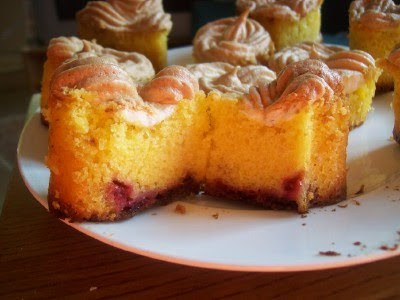
TWD : Rum-Drenched Vanilla Cakes

Sunday, June 27, 2010
Daring Baker's Challenge: Chocolate Pavlovas and Chocolate Mascarpone Mousse

The June 2010 Daring Bakers’ challenge was hosted by Dawn of Doable and Delicious. Dawn challenged the Daring Bakers’ to make Chocolate Pavlovas and Chocolate Mascarpone Mousse. The challenge recipe is based on a recipe from the book Chocolate Epiphany by Francois Payard

Recipe 1: Chocolate Meringue (for the chocolate Pavlova):
Directions:
- Place a rack in the center of the oven and preheat to 200º F (95º C) degrees. Line two baking sheets with silpat or parchment and set aside.
- Put the egg whites in a bowl and whip until soft peaks form. Increase speed to high and gradually add granulated sugar about 1 tbsp at a time until stiff peaks form. (The whites should be firm but moist.)
- Sift the confectioner’s sugar and cocoa powder over the egg whites and fold the dry ingredients into the white. (This looks like it will not happen. Fold gently and it will eventually come together.)
- Fill a pastry bag with the meringue. Pipe the meringue into whatever shapes you desire. Alternatively, you could just free form your shapes and level them a bit with the back of a spoon. (Class made rounds, hearts, diamonds and an attempt at a clover was made!)
- Bake for 2-3 hours until the meringues become dry and crisp. Cool and store in an airtight container for up to 3 days.
Recipe 2: Chocolate Mascarpone Mousse (for the top of the Pavlova base):
Directions:
- Put ½ cup (120 mls) of the heavy cream and the lemon zest in a saucepan over medium high heat. Once warm, add the chocolate and whisk until melted and smooth. Transfer the mixture to a bowl and let sit at room temperature until cool.
- Place the mascarpone, the remaining cup of cream and nutmeg in a bowl. Whip on low for a minute until the mascarpone is loose. Add the Grand Marnier and whip on medium speed until it holds soft peaks. (DO NOT OVERBEAT AS THE MASCARPONE WILL BREAK.)
- Mix about ¼ of the mascarpone mixture into the chocolate to lighten. Fold in the remaining mascarpone until well incorporated. Fill a pastry bag with the mousse. Again, you could just free form mousse on top of the pavlova.
Recipe 3: Mascarpone Cream (for drizzling):
Directions:
- Prepare the crème anglaise. Slowly whisk in the mascarpone and the Sambucca and let the mixture cool. Put the cream in a bowl and beat with electric mixer until very soft peaks are formed. Fold the cream into the mascarpone mixture.
Recipe 4: Crème Anglaise (a component of the Mascarpone Cream above):
Directions:
- In a bowl, whisk together the egg yolks and sugar until the mixture turns pale yellow.
- Combine the milk, cream and vanilla in a saucepan over medium high heat, bringing the mixture to a boil. Take off the heat.
- Pour about ½ cup of the hot liquid into the yolk mixture, whisking constantly to keep from making scrambled eggs. Pour the yolk mixture into the pan with the remaining cream mixture and put the heat back on medium. Stir constantly with a wooden spoon until the mixture thickens enough to lightly coat the back of a wooden spoon. DO NOT OVERCOOK.
- Remove the mixture from the heat and strain it through a fine mesh sieve into a bowl. Cover and refrigerate until the mixture is thoroughly chilled, about 2 hours or overnight.
Tuesday, June 22, 2010
TWD : Dressy Chocolate Loafcake

Sunday, June 20, 2010
The Cake Slice : Shenandoah Valley Blueberry Cake

Tuesday, June 15, 2010
TWD : Raisin Swirl Bread

Monday, June 14, 2010
Daring Cooks' Challenge : Tricolor Patè


Recipes:
Three Spice Liver Pâté
Yields one 25 by 12,5 cm (10 by 5 inch) terrine or loaf pan
1 lb / 454 grams pork liver (or beef or combination)
1/2 lb / 227 grams ground pork
1/2 lb / 227 grams pork fat (or pork belly)
2 cloves garlic
2 shallots
1 whole egg and 1 egg yolk
1/2 tsp / 2 ml cinnamon
1/2 tsp / 2 ml coriander (ground or crushed)
1/2 tsp / 2 ml cumin
3/4 tsp / 3 ml salt
1 tbps / 15 ml coarse freshly cracked peppercorns
2 tbps / 30 ml cognac
2 bay leaves
1 package of bacon
Preheat oven to to 350ºF (180ºC).
Cut liver and pork fat into small pieces and add to food processor. Add ground pork, garlic, shallots, cinnamon, cumin, coriander, salt and pepper. Grind until smooth.
In mixing bowl, incorporate the meat and liver mixture with the cognac and eggs.
Line bottom of baking or ceramic pan with overlapping pieces of bacon. Place a bay leaf on the bottom and then fill with meat/liver mixture. Cover top with another bay leaf and then overlapping pieces of bacon.
Place in oven in the larger baking pan and add enough water to cover 2/3rds of the pan containing the meat/liver mixture. Bake for about 1-1.5 hrs.
The pâté will contract and the juices will be on the bottom. Allow to cool and soak up the juices. Remove any excess bacon and discard the bay leaves.
Chicken Liver Terrine
Yields one 25 by 12,5 cm (10 by 5 inch) terrine or loaf pan
1 tbsp duck fat, or butter
2 onions, coarsely chopped
300g (11 oz) chicken livers, trimmed
3 tbsp brandy, or any other liqueur (optional)
100g (3 1/2 oz, 1/2 cup) smoked bacon, diced
300g (11 oz) boneless pork belly, coarsely ground
200g (7 oz) boneless pork blade (shoulder), coarsely ground (or ground pork see note below)
2 shallots, chopped
1 tsp quatre-épices (or 1/4tsp each of ground pepper, cloves, nutmeg and ginger is close enough)
2 eggs
200 ml (7 fl oz, 3/4 cup + 2 tbsp) heavy cream
2 fresh thyme sprigs, chopped
Salt and pepper
NOTE: If you cannot find ground pork belly or blade, buy it whole, cut it into chunks, and pulse in the food processor. You can also replace the pork blade with regular ground pork.
Preheat oven to 200ºC (400ºF, Gas Mark 6).
Melt the fat or butter in a heavy frying pan over low heat. Add the onions and cook, stirring occasionally, for 5 minutes, until softened. Add the chicken livers and cook, stirring frequently, for about 5 minutes, until browned but still slightly pink on the inside.
Remove the pan from heat. Pour in the brandy, light a match and carefully ignite the alcohol to flambé. Wait for the flames to go out on their own, carefully tilting the pan to ensure even flavoring. Set aside.
Put the minced pork belly and blade in a food processor, then add the onion-liver mixture and the chopped shallots, and pulse until you obtain a homogenous mixture – make sure not to reduce it to a slurry.
Transfer to a bowl, and gradually stir in the chopped bacon, quatre-épices, cream, eggs, and thyme. Season with salt and pepper, and mix well. Spoon the mixture into a terrine or loaf pan, and cover with the terrine lid or with aluminum foil.
Prepare a water bath: place the loaf pan in a larger, deep ovenproof dish (such as a brownie pan or a baking dish). Bring some water to a simmer and carefully pour it in the larger dish. The water should reach approximately halfway up the loaf pan.
Put the water bath and the loaf pan in the oven, and bake for 2 hours. Uncover and bake for another 30 minutes. The terrine should be cooked through, and you should be able to slice into it with a knife and leave a mark, but it shouldn’t be too dry. Refrigerate, as this pâté needs to be served cold. Unmold onto a serving platter, cut into slices, and serve with bread.
NOTE: This pâté freezes well. Divide it into manageable portions, wrap tightly in plastic film, put in a freezer Ziploc bag, and freeze. Defrost overnight in the fridge before eating.
Tricolor Vegetable Pâté
Yields one 25 by 12,5 cm (10 by 5 inch) terrine or loaf pan
Line your pan with plastic wrap, overlapping sides.
White Bean Layer
2 x 15-ounce / 900 ml cans cannellini (white kidney beans), rinsed, drained thoroughly
1 tbsp / 15 ml fresh lemon juice
1 tbsp / 15 ml olive oil
1 tbsp / 15 ml minced fresh oregano or 1 teaspoon dried
2 garlic cloves, pressed
Mash beans in large bowl. Add lemon juice, olive oil, oregano and garlic and blend until smooth. Season to taste with salt and pepper. Spread bean mixture evenly on bottom of prepared pan.
Red Pepper Layer
7-ounce / 210 ml jar roasted red bell peppers, drained, chopped
3/4 cup / 180 ml crumbled feta cheese (about 4 ounces)
Combine peppers and feta in processor and blend until smooth. Spread pepper mixture evenly over bean layer in prepared dish.
Pesto Layer
2 garlic cloves
1 cup / 240 ml fresh basil leaves
1 cup / 240 ml fresh Italian parsley leaves
1/4 cup / 60 ml toasted pine nuts
3 tbsp / 45 ml olive oil
1/2 cup / 120 ml low-fat ricotta cheese
Mince garlic in processor. Add basil, parsley and pine nuts and mince. With machine running, gradually add oil through feed tube and process until smooth. Mix in ricotta. Spread pesto evenly over red pepper layer.
Cover with plastic wrap and refrigerate overnight.
To unmold, invert pâté onto serving platter. Peel off plastic wrap from pâté. Garnish with herb sprigs and serve with sourdough bread slices.
Trout and Shrimp Pâté
Yields one 6x3 inch (15x7,5 cm) terrine or loaf pan
1 tbsp / 15 ml butter
1/4 lb / 4 oz / 120g medium raw shrimp, deveined, shelled and tailed (about 12 medium shrimp)
1/8 cup / 30ml Grand Marnier (or cognac, or another strong liqueur of your choice) (optional)
1/2 lb / 8 oz / 240g trout filet, skinned and cut into thick chunks
1/4 lb / 4 oz / 110g raw shrimp, deveined, shelled and tailed (any size)
3/4 cup / 180ml heavy cream
Salt, to taste
Green peppercorn, coarsely ground, to taste
Chives, for garnish
Preheat oven to 375ºF (190ºC).
In a heavy, flameproof frying pan, melt the butter over medium-high heat. Sauté the 1/4 pound of medium shrimp, stirring often, until pink and cooked through. Remove the pan from heat. (NOTE: These shrimp will be used to form layers within your pâté. If you feel they are too thick – like the ones in the photograph, you might want to slice them in half lengthwise.)
Pour the Grand Marnier over the cooked shrimp. Light a match and carefully ignite the alcohol, to flambé the shrimp. Wait for the flames to go out on their own, carefully tilting the pan to ensure even flavoring. Set aside.
Put the trout and the remaining raw shrimp in a food processor and pulse. Gradually pour in the cream and keep pulsing until you obtain a smooth mixture that is easy to spread, but not too liquid (you may not need to use all the cream). Season with salt and green pepper.
Butter a 6x3 inch (15x7,5 cm) loaf pan or terrine, then line it with parchment paper. Spoon in half the trout mixture, and spread it evenly. Place the flambéed shrimp on top, in an even layer, reserving 3 or 4 shrimp for decorating. Top with the remaining trout mixture.
Prepare a water bath: place the loaf pan in a larger, deep ovenproof dish (such as a brownie pan or a baking dish). Bring some water to a simmer and carefully pour it in the larger dish. The water should reach approximately halfway up the loaf pan.
Put the water bath and terrine in the oven, and bake for 35 minutes. The pâté should be cooked through and firm in the center.
Remove the pan from the water bath and let cool. Carefully unmold onto a serving platter. Decorate with the reserved shrimp, and sprinkle with chopped chives. Cut into thick slices and serve at room temperature, with crusty bread.
Tuesday, June 8, 2010
TWD : Tender Shortcakes

Tuesday, June 1, 2010
TWD : White Chocolate Brownies


Monday, May 31, 2010
Meringhe Veneziane


Saturday, May 29, 2010
Daring Baker's Challenge: Piece Montée

Preparation time: You will want to use your puff pastry batter and chocolate glaze or caramel as soon as it has been prepared and as close to serving time as possible. This is not a dessert that stores well and it may be a bit temperamental in humid areas as the glaze needs to harden to hold the choux together. The crème patissiere can be made a couple of days in advance and stored in the fridge until ready to use.
You will need approximately 10 minutes to prepare the puff pastry, 10 minutes to pipe and about 30 minutes to bake each batch. The crème patissiere should take about 10 minutes to cook and then will need to be cooled for at least 6 hours or overnight. The glazes take about 10 minutes to prepare.
Equipment required:
• several baking sheets
• parchment paper
• a whisk
• a pastry brush (for the egg wash)
• a pastry bag and tip (a plain tip or no tip is best for piping the puff pastry; you can use a plain or star tip to fill the puff pastry with the cream)
• a flat surface such as a baking sheet or cake board/stand on which to assemble your piece montée
• some of the items you may want to use to decorate your piece montée include ribbons, Jordan almonds, fresh flowers, sugar cookie cut-outs, chocolates, etc.
Ingredients:
For the Vanilla Crème Patissiere (Half Batch)
1 cup (225 ml.) whole milk
2 Tbsp. cornstarch
6 Tbsp. (100 g.) sugar
1 large egg
2 large egg yolks
2 Tbsp. (30 g.) unsalted butter
1 Tsp. Vanilla
Dissolve cornstarch in ¼ cup of milk. Combine the remaining milk with the sugar in a saucepan; bring to boil; remove from heat.
Beat the whole egg, then the yolks into the cornstarch mixture. Pour 1/3 of boiling milk into the egg mixture, whisking constantly so that the eggs do not begin to cook.
Return the remaining milk to boil. Pour in the hot egg mixture in a stream, continuing whisking.
Continue whisking (this is important – you do not want the eggs to solidify/cook) until the cream thickens and comes to a boil. Remove from heat and beat in the butter and vanilla.
Pour cream into a stainless steel/ceramic bowl. Press plastic wrap firmly against the surface. Chill immediately and until ready to use.
For Chocolate Pastry Cream (Half Batch Recipe):
Bring ¼ cup (about 50 cl.) milk to a boil in a small pan; remove from heat and add in 3 ounces (about 80 g.) semisweet chocolate, finely chopped, and mix until smooth. Whisk into pastry cream when you add the butter and vanilla.
For Coffee Pastry Cream (Half Batch recipe)
Dissolve 1 ½ teaspoons instant espresso powder in 1 ½ teaspoons boiling water. Whisk into pastry cream with butter and vanilla.
Pate a Choux (Yield: About 28)
¾ cup (175 ml.) water
6 Tbsp. (85 g.) unsalted butter
¼ Tsp. salt
1 Tbsp. sugar
1 cup (125 g.) all-purpose flour
4 large eggs
For Egg Wash: 1 egg and pinch of salt
Pre-heat oven to 425◦F/220◦C degrees. Line two baking sheets with parchment paper.
Preparing batter:
Combine water, butter, salt and sugar in a saucepan over medium heat. Bring to a boil and stir occasionally. At boil, remove from heat and sift in the flour, stirring to combine completely.
Return to heat and cook, stirring constantly until the batter dries slightly and begins to pull away from the sides of the pan.
Transfer to a bowl and stir with a wooden spoon 1 minute to cool slightly.
Add 1 egg. The batter will appear loose and shiny.
As you stir, the batter will become dry-looking like lightly buttered mashed potatoes.
It is at this point that you will add in the next egg. Repeat until you have incorporated all the eggs.
Piping:
Transfer batter to a pastry bag fitted with a large open tip (I piped directly from the bag opening without a tip). Pipe choux about 1 inch-part in the baking sheets. Choux should be about 1 inch high about 1 inch wide.
Using a clean finger dipped in hot water, gently press down on any tips that have formed on the top of choux when piping. You want them to retain their ball shape, but be smoothly curved on top.
Brush tops with egg wash (1 egg lightly beaten with pinch of salt).
Baking:
Bake the choux at 425◦F/220◦C degrees until well-puffed and turning lightly golden in color, about 10 minutes.
Lower the temperature to 350◦F/180◦C degrees and continue baking until well-colored and dry, about 20 minutes more. Remove to a rack and cool.
Can be stored in a airtight box overnight.
Filling:
When you are ready to assemble your piece montée, using a plain pastry tip, pierce the bottom of each choux. Fill the choux with pastry cream using either the same tip or a star tip, and place on a paper-lined sheet. Choux can be refrigerated briefly at this point while you make your glaze.
Use one of these to top your choux and assemble your piece montée.
Chocolate Glaze:
8 ounces/200 g. finely chopped chocolate (use the finest quality you can afford as the taste will be quite pronounced; I recommend semi-sweet)
Melt chocolate in microwave or double boiler. Stir at regular intervals to avoid burning. Use the best quality chocolate you can afford. Use immediately.
Hard Caramel Glaze:
1 cup (225 g.) sugar
½ teaspoon lemon juice
Combine sugar and lemon juice in a saucepan with a metal kitchen spoon stirring until the sugar resembles wet sand. Place on medium heat; heat without stirring until sugar starts to melt around the sides of the pan and the center begins to smoke. Begin to stir sugar. Continue heating, stirring occasionally until the sugar is a clear, amber color. Remove from heat immediately; place bottom of pan in ice water to stop the cooking. Use immediately.
Assembly of your Piece Montée:
You may want to lay out your unfilled, unglazed choux in a practice design to get a feel for how to assemble the final dessert. For example, if making a conical shape, trace a circle (no bigger than 8 inches) on a piece of parchment to use as a pattern. Then take some of the larger choux and assemble them in the circle for the bottom layer. Practice seeing which pieces fit together best.
Once you are ready to assemble your piece montée, dip the top of each choux in your glaze (careful it may be still hot!), and start assembling on your cake board/plate/sheet. Continue dipping and adding choux in levels using the glaze to hold them together as you build up. (You may want to use toothpicks to hold them in place – see video #4 below).
When you have finished the design of your piece montée, you may drizzle with remaining glaze or use ribbons, sugar cookie cut-outs, almonds, flowers, etc. to decorate. Have fun and enjoy! Bon appétit!
Additional Information: Here are some videos you may want to take a look at before you get started on your piece montée.
1) Martha Stewart Assembles a Croquembouche:
http://www.marthastewart.com/recipe/marthas-famous-croquembouche
2) Assembling croquembouche using the interior of a cylinder:
http://www.youtube.com/watch?v=Fq-UgMxe0Y4
3) Asembling Free-standing Croquembouche with Chocolate Glaze:
http://www.youtube.com/watch?v=ZrIanD5pi9E&feature=related
4) Assembling a Croquembouche with Toothpicks and Cone:
http://www.youtube.com/watch?v=vIGaidsM-NI&feature=related
See this google images search of Croquembouche for inspiration:
http://images.google.com/images?hl=en&source=hp&q=croquembouche&btnG=Sea...
Here’s a link to a dairy-free pate a choux and crème patisserie recipe:
http://dairyfreecooking.about.com/od/dessertsbeverages/r/creampuffs.htm